Sunday, January 30, 2011

Tu B'Shevat

The kindergarten children walked into class one morning to find the discovery table filled with all kinds of unique (and very cool) things! "Wow!" said one child as he approached the table, "This is so cool! Can I touch it, can I try it out?" As the early arriver began to explore the discovery table, more children filtered into the classroom, and were immediately drawn to the area. "Morah said we can play with it!", said the first child who had really begun to investigate the items!

As the children began to explore the items, they also began to notice the pictures that had been posted in the area. Their faces lit up, as they began to make the connections. "Hey, this is water stuff, because it's Tu B'Shevat." "Ya, there are pipes and stuff!" "So," I asked, "Why are there pipes? What do pipes and water stuff have to do with Tu B'Shevat?" "Pipes take water to plants. We eat the fruit on Tu B'Shevat!", answered one friend.

Another friend was busy examining the pictures. "This guy is fixing pipes. Maybe it broke so the dirt was digged out and the soil went down to the other soil. Then, they turned off the water so they could fix the pipe!" "Interesting", I said, "So what makes you think the water was turned off?" "Well, if it wasn't there would be water coming out and he couldn't fix the pipe!", he answered!

When we came together at meeting, the children could not stop talking about their plans for the new materials. "I know, we can make a water park!" "Let's make a pool. " "We can just pipe it all together!" I asked the children where the water comes from that we use to bring to the plants. They responded, "oceans, rivers, the sea!" Why do we need to bring the plants water?" I asked. "Well, sometimes it doesn't rain enough and the plants will die."

Next, we made a list of all the things that plants need to grow. As we made our list, we talked about how different plants grow in different climates. We came to understand that ALL plants need the same things, but that plants need DIFFERENT amounts of those things! When we bring the water to the plants with a pipe system, it is called irrigation!

So why talk about irrigation on Tu B'Shevat? Well, Tu B'Shevat marks each agricultural year. The Torah tells us to not partake of the produce from a tree for the first 3 years of a tree's life. On Tu B'Shevat, we begin the yearly count. We depend on and value the produce that comes from trees. Through the implementation of irrigation systems, we take responsiblity for the care and growth of trees and plants. The children examined a map of Israel, and noticed that the Southern part of Israel is mostly desert. They were able to see that by developing the irrigation system in Israel, water from the North of the country gets carried to the Southern desert areas, and thus trees and plants can grow there too!

Our Tu B'Shevat experience also included a shopping trip to the PreK's fruit market! The Kindergarten children prepared coupons to bring to the market, that they used to "shop" for fruit. As the market was closing, the entire Zimmer Preschool and Kindergarten joined in a yummy TuB'Shevat treat!

Sunday, January 23, 2011

Winter

The winter weather provided the perfect topic for our kindergarten children to experiment with writing their own Haiku. Breaking words into syllables helps us with letter sound recognition, blending sounds and spelling. A Haiku is a 3 line non-rhyming poem. The first and third line each have 5 syllables and the second line has seven syllables. We read together, If Not For the Cat, by Jack Prelutsky. It was a delightful book of Haiku poems that had us guessing about whom the author wrote. The children then set about writing their own “Who Am I?” Haiku poem about things we see in the winter. Here are a couple of poems the children wrote. Can you guess, “Who am I?”


“Falling down softly
 I feel cold and wet and white
 Children like to play!”

“I have three white balls
 I have buttons and a hat
 My name is Frosty”

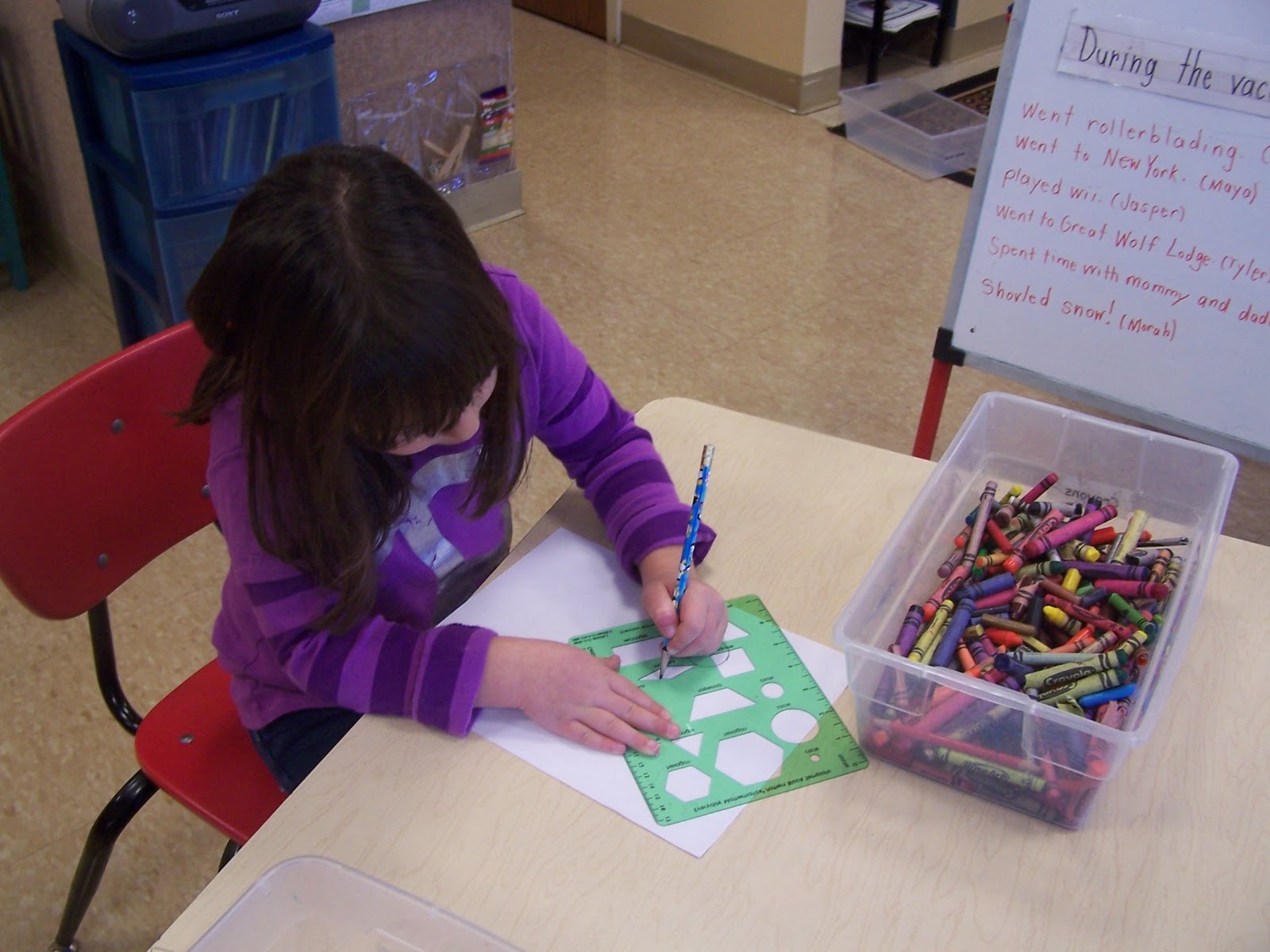
Working with pattern blocks is fun and familiar to the children. Recently we introduced the pattern block template. We used the template to create unique people and animals. Each child traced 10 shapes from the template to make their creation. The challenge was to select the 10 shapes in such a way to construct the different body parts. The children made people, birds, cats and dogs!

Story mapping helps us to understand the structure of the story. We identify the characters and the setting of the story. Finally, we begin to understand how to summarize the story by recalling the beginning, middle and end. Working with our shared reading book, Let’s Have A Swim, the children worked together to create a large story map.


Then, each of the children selected his or her favorite winter sport to write about in a similar story. Each child selected a title and created a story map for his/her story. Finally, we illustrated our work. Check them out in our front lobby!

Sunday, December 19, 2010

Kindergarten in December

Birthdays are a time for celebration…but they are also a time for self-reflection. Our kindergarten children focus throughout the year on becoming their “best self.” We take the time to talk about what our “best self” looks like to us…and what we need to do to achieve that goal. While our birthday marks a year of physical growth, it is also another year of awareness and emotional development. We realize that as an individual, “I” can affect the world in my own unique way. Acknowledging a child’s birthday in a way that says: “You are important and unique - Only you can choose the way to use your gifts and talents to shape the world we share!” sends the message that each child is valued and has purpose. This message guides the child towards their potential…their best self. On our birthday at school, we invite our family to come share the special day with us! We think about a blessing we would like to offer our friends in honor of our birthday! This friend blessed his classmates with “a happy life!”


Each week the children learn a new Hebrew letter. When we learned the letter Tet, Rabbi Yitzchok came to the kindergarten to teach us about the tallit טַלִּית
He showed us how to put on a tallit and how to wear it properly when praying.
We love to discover new things and our science center is the perfect place for the children to do some investigative work. Working with a reference book on rocks, the children use magnifying glasses to check out our own rock collection, record their observations and compare it to the pictures they found in the book! Working on our own and with our friends in this way, builds our self-confidence and critical thinking skills. Our library of science books and magazines are also a popular choice during center time!


 Creative thinking, problem solving and team work shine when we work with pattern blocks. The children enjoy suggesting an idea to a friend and then working together to create it with the pattern blocks. Here the children made an elaborate flower together!

This month the children had an opportunity to learn about the public library. We took a class trip to the Bernards Township Library where they received a tour and learned how the library was organized. Then, they got to hear two stories. The first story, Squirrel’s New Year’s Resolution, prompted us to discuss what a resolution means, and write our own resolutions for the New Year when we returned to school. The second book, Snowman at Night, had us using our imaginations! Inspired from the book, the children’s journal prompt asked them what they would do if they were a snowman, and what they would wear if they were snowmen! Finally, the children made a snowman to “dress up” as they described! Looking ahead to January, we can’t wait for some snow to make our own “real” snowman!


Sunday, December 5, 2010

Happy Chanukah!


The kindergarten children have been exploring Chanukah through many lenses. As each of us work towards becoming our best self every day, we think about our values, morals and beliefs to help us on our journey. We focus on our best habits to in order to build our moral character. The journey is not always an easy one, and the story of Chanukah reminded us that even when it is difficult for us, we always try to do what we know is right!


After retelling the story of Chanukah, the children discussed how hard it must have been for the Jewish people to remain strong in their beliefs when others around them told them they should believe in something different. We always remember that Hashem loves us and protects us. This helps us everyday when we are faced with difficult situations. We recognized that we struggle sometimes to do the right thing, even when we know we should! One friend offered, “I can help my friends do the right thing, when I do the right thing!” Another friend suggested, “When I feel like being silly, I can try harder!”

Chanukah also reminded us that we are a classroom community! Just like the Macabees stood in their beliefs together, we as a community work and play together. Many of our hands on Chanukah experiences saw our friends helping each other and working together. Sharing Chanukah in this way, makes us feel connected to each other and to the Jewish community!

Dreidel is always a Chanukah favorite, and we added a fun twist to it! We graphed our results after spinning the dreidel. This was a wonderful opportunity for us to discuss the concept probability. We used our completed graphs to compare our results!

Crafting our own menorah to use this Chanukah gave the children an opportunity to work with clay. As each child came up with different ideas about color patterns, and how to fashion the clay, it was a pleasure to hear them exclaim, “Oh…I love that! Can you show me how you did that?” “That looks so pretty!” “Can you help me shape it like yours?” Working together on their own individual menorahs, the children displayed their own unique creativity with sensitivity and true Chanukah spirit!


 Our classroom needed some beautiful Chanukah decorations, and the children were delighted to make dreidel prints to hang about the classroom. Using sponges and paint, they children stamped out dreidel prints. After they dried, they cut out their dreidels and used glue to “write” the Hebrew letters (nun, shin, gimmel, hay) and added glitter to make them sparkle! They proved to be just the right Chanukah touch for our class!


Each day of Chanukah, the kindergarten children join the rest of our Zimmer friends to light our beautiful menorah in our lobby. We recite the blessings together and then join in song! This wonderful tradition has become our favorite part of the day. We love seeing our siblings, friends and Morahs and sharing this special time together. We light the menorah each day at 11:30 in the morning. Stop in and join us during these remaining days of Chanukah!

Happy Chanukah!

Saturday, November 27, 2010

Thanksgiving

The kindergarten children came to understand the story of Thanksgiving as a story of how people (The Native Americans) helped people who really needed help (The Pilgrims). Without the help the Native Americans shared with the Pilgrims, the Pilgrims would have perished. We discussed that it is our obligation to help others who are in need. We read stories that demonstrated real life situations about people who needed help, and those who helped them. In doing so, we realized, that it is not always easy for us to help, but that even when it is not easy for us, it is still our obligation to help! The children brainstormed together and shared their ideas!


I asked the children, who do you think needs "help"? The overwhelming response was "poor people!" "Okay, I said, who are poor people, and how can you help them?" "Poor people don't have money!" "Why do we need money?" I asked. "To buy food, and poor people need more money to buy food...or they need people to give them food." "So", I asked, "How can you help?" One friend suggested that they could do chores at home for money and use some birthday money to give for tzedakah! Or, "We can ask our parents to help us bake food for people!" "I could sell some toys that are in good condition, then I can have money to give to tzedakah!"


"Great start" I said, Let's think about other ways we can help people. A friend offered, “we could make a picture book to bring to a sick child in the hospital. I think it would make them happy because a kid came to see them!” "Yes, "I'm sure children who are not well and are in the hospital would really appreciate having a "friend" come see them with something so special. How do you think you would feel by going to see them?" "I would feel happy too, because I could make them happy!"

"Let's think about all the things we have, that not everyone is so fortunate to have!" "Yea, like we have a house to live in, and not everyone does." "That's right," I said. Remember the book we read, The Lady in the Box...where did she live?" "She did not have a home anymore, she was homeless and it was winter in the story." Thinking about the cold weather, one friend said “I could knit a scarf, instead of playing to give to someone who needs it!” "What else could we do?" "Collect blankets!" "Knit blankets!" "Bring them a meal" "Go Help at a Soup Kitchen!"

"Those are all such wonderful ideas. I'm thinking though, should we only do these things now because it's Thanksgiving time? "No, we always need to see how we can help other people!!"  As we studied the Thanksgiving holiday, the children wrote about and illustrated their recollections and thoughts in their journals.

Of course, our study concluded in sharing a Thanksgiving Feast with all of Zimmer Preschool and Olam Academy! The kindergarten children worked together to prepare a yummy Apple-Cranberry Bread Pudding. From start (peeling and chopping the apples) to finish (cutting up the bread pudding to serve) the children delighted in the experience! We got to practice our measuring skills, along with peel, chop, cut, stir, mix and enjoy! Sharing this special meal with our family and friends was a wonderful way to begin our Thanksgiving holiday!


Sunday, November 7, 2010

We learn in many different ways!

 
The kindergarten child is enthusiastic about his/her environment and curious to learn more about the world around him/her. At Zimmer we help stimulate their interests and provoke a desire to learn in many different ways.


As the season of autumn transformed our world outside, we read together, Why Do Leaves Change Colors? When we were outside one afternoon we noticed a tree whose leaves had begun to change color. The children pointed out that only the leaves on the top part of the tree where turning from green to orange. The leaves closer to the trunk of the tree remained green. “Why do you suppose the leaves are changing color in this way?” I asked the children. They speculated, “the leaves on the bottom stay warmer longer”, “the leaves on the top lost their green first!” After observing the tree, we came into the classroom and carefully drew sketches of the tree. We will continue to observe the same tree and record our observations throughout the year.

Games are a fun and familiar way for the kindergarten child to learn. Number recognition and counting are practiced in this game. The children are also developing important social skills as they play the game together.


Listening to stories helps us develop vocabulary, comprehension, and grammar. Through discussion we begin to understand sequencing, story structure and genre. Active listening is an important life long skill. The kindergarten children hear stories from guest readers, such as Mrs. Zimmer who recently read, It Could Always Be Worse, and Morah Ann (our Head of School) who read, The Keeping Quilt. Finally, at the end of each day, the children can’t wait to hear me read another chapter in the book, Pippi Longstocking.

Working on puzzles is a great way to boost memory and problem solving skills as well as improving hand-eye coordination. The children work together to complete a common task and feel great about their shared accomplishment!


Play doh is a great tool for building the fine motor muscles we need for proper handwriting. As we are learning to recognize numbers, the children use the Play doh to “write” the numbers they know!

Many group activities reinforce letter sound recognition in our classroom. We use the computer to further individualize each child’s learning. These activities are tailored to the meet the individual needs of each child. Using the mouse, promotes hand-eye coordination. Working individually boosts our self-confidence!


Sharing special celebrations builds our sense of community as a class, and as a school. The Kindergarten and Kitah Alef share Kabbalat Shabbat together each Friday afternoon. As our guests, the Kitah Alef class helps us to learn the Shabbat songs and blessings. Sharing this special time is the perfect way to end our week as we all prepare to welcome Shabbat!