Sunday, October 24, 2010

Developing Skills

The ability to engage in thoughtful dialogue is a skill that must be practiced with intention and developed as we mature, grow and gain a sense self and others. Practicing the “art of conversation”, promotes good listening, meaningful query, and reflection. While these skills may seem like a “tall order” for kindergarten, these are indeed the skills we work on everyday.

 During “Share” at morning meeting, both the speaker and audience assume responsibilities for their part of the conversation. The speaker (the child who is sharing), has an opportunity to “share” a story or an object that is relevant or important to them with his or her classmates. He or she needs to speak in a loud enough voice for all to hear, and present the information in a way that is understandable and interesting to the audience. The audience needs to be respectful, looking at our speaker and listening actively. It is anticipated that our audience will be thinking of a question or comment to ask of our speaker. It is often tempting to “interrupt” our speaker, but working through the format in this way, helps up develop those good habits that become lifelong skills.

Sharing information and stories about our self, gives our friends an opportunity to get to know us “outside” the classroom thus promoting and deepening our friendships. One classmate used just this opportunity to share this grandmother with us! She lives in Australia and was here in NJ, visiting the family! This very special “share” led to a geography lesson about Australia, (and the introduction of an Atlas to our class), the types of animals that live in Australia, the climate and a super song session featuring, “Kookaburra sits in the Old Gum Tree!”

Working with information that is relevant to us, helps us to make sense of the world around us. Collecting, recording and organizing data helps us to analyze information, solve problems and draw conclusions. Everyday when the children come into class, they record their attendance on our class attendance graph. When children forget to check themselves on the graph, another child can often be heard telling them that they forget!

Seeing the information recorded in this way, it becomes easy for fellow students to detect who is absent, and who forgot to sign our chart! We also organized our birthdays and ages on respective graphs to help us anticipate and prepare to meet this milestone together. Since doing so, the children enjoy putting themselves in “age order”…sometimes, oldest to youngest, sometimes, youngest to oldest! As they “see” the information organized, they are able to use it in a way that is meaningful to them!

Speaking of birthdays, we celebrated our first friend who turned six this year! As a class, we worked together to prepare a special birthday cake. Our birthday boy’s mom and sister joined us for a fun morning of stories and song. We enjoyed this opportunity to use our freshly painted rhythm sticks to help us “tap out the beat!” When we celebrate our birthday, we like to reflect on how we can help bring kindness to the world. Because each of us is unique, only we can affect the world in our own special way. Our birthday friend often shares his generosity with our class! He is always ready to help a friend who can not locate a pencil or glue stick….”here! you can use mine!” Realizing and internalizing these simple acts of kindness, makes us become aware that we can truly affect the world in a positive a way!

The story of Creation came alive as the children worked on a Creation Mural together! Each child selected one color we see in the world and set about making those things for our Creation Mural. For example, the child who selected yellow, made the sun, the child who selected blue, made the sky and the water! As the mural took shape, the children and I discussed what was missing, and the children decided amongst themselves who would make those pieces. Other children took on the role of “gluers” and glued each piece to the mural as they were completed! As we worked, one child remarked, “This is all of ours very best work!” Indeed it was! I was so proud of how they all worked enthusiastically and cooperatively together! When it was complete, their pride shone, as we discussed all they had learned, and admired their hard work!


Saturday, September 25, 2010

It's All About the Quality

It’s all about the quality…but don’t think we’re not having fun too! Last month, The New York Times featured an article, “Want to make $1000 More A Tear? Try Kindergarten” (http://www.npr.org/templates/story/story.php?storyID=129187436&f…) (August 14, 2010, NPR Staff). Harvard economist, Raj Chetty explains that an “excellent-quality class” is worth the investment for your child’s future. His study determined that a quality kindergarten program is the catalyst for developing positive social and emotional skills as well as academic skills. And, it is these skills that help us to become successful adults. Who doesn’t want that for their child?


In these difficult economic times, I can see how one might consider spending money on a private kindergarten education a bit daunting. But, The Zimmer School’s commitment to authentic learning experiences might just be the catalyst for inspiring your child’s future success!

At Zimmer, we create our environment with intention. With a natural inspired backdrop, each area of the classroom is carefully planned and stocked with evocative materials based on clear objectives for how the space will be used. Safety is always our priority in planning each space. Our beautiful grounds and access to the surrounding woods and river, beckons us to a classroom outdoors! The Zimmer teacher is trained to provoke thought and inquiry through meaningful dialogue with each child. Deep respect is always demonstrated toward the child and his/her opinion, point of view and interests. The small class size allows for discovering and embracing the children’s interests. Ultimately, our children love to learn!
Academics are based on the state standards, and each child is permitted the time and space to grow, mature and learn at an individual pace. As we began this school year together, so began a New Year as we greeted Rosh Hashanah. We learned new routines, like signing in and marking our self “here” on the attendance chart. Each day we look forward to the message Morah has written for us to respond to in our journals! Learning proper handwriting is a lesson in “fun” as we use our fingers, chalk, and damp sponges to practice forming letters on individual chalkboards.

We explored our surroundings outside! A walk to the river prompted wonder and amazement after the children discovered an “empty” turtle shell. The large river’s bank gave way to discussion about the height of the river! “Look Morah, I can see the roots of those trees!” exclaimed one child. “Why do you suppose that is?” I asked. The children looked around. “I know, because water used to be there and now it’s not!” a child explained. “Well, if that’s true, would that mean that we are standing on what was once water?” I asked. “Yes!” they said. “Well, how can that be?” I asked. The children thought for a bit and offered: “Well, it went into the mud!” “It is hot, it dried up!” “We need rain!” As one child looked up at the tree he asked, “Morah, can that tree fall down now?” “Hmmm, interesting, what do you think?” I asked!

Learning math is always fun at Zimmer kindergarten. The Everyday Mathematics curriculum helps children make those real life connections to math in their “everyday” lives! Math has a purpose, and it’s fun. Exploring measurement led us in to discussing whether the height of our bodies would determine the length of our feet! Well, there was one way to find out! First, the children measured themselves “back to back” in order to put themselves in height order. Okay, that was fun! But would the size of our feet measure up in the same order? Determined to find out, the children traced their foot, cut it out, colored it then they carefully measured each foot cutout. We made sure to match the bottom of each foot in
order to accurately measure them. Can you guess what we discovered?

Reading is fun, but it is most fun when reading to a buddy. The children were delighted to share some stories with a reading buddy of their choice…a furry stuffed animal. The children love our cozy library. After reading our first shared reading book, Birthdays, they can often be found reading it to their buddy! We also enjoy reading High Five, a fun magazine published for children.

Our office area is perhaps one of the most popular. Morah’s old college typewriter is once again getting plenty of use! Learning to put the paper in and finding the proper key to return the carriage was fascinating! But, locating the keys to type our name…was perhaps our greatest discovery! Of course, the stamps, ABC tiles, stencils, rhyming props, finger puppets and more….have also been a source of great discovery and fun.


Building builds patience, coordination, planning skills, friendships and pure enjoyment. An interesting mix of blocks, tubes, tools, animals, Lincoln logs and mini furniture pieces makes for tremendous potential! The children work together to develop ideas, problem solve and overcome “creative differences.” Cleanup often involves a strategy, “you get the window blocks, and I’ll get the tubes!” And as the end of our day nears, and the children anxiously clean up so we can share our memorable part of the day with each other and hear a story, I often overhear, “I can help clean up, even though I didn’t play in blocks today!” We are truly building a beautiful community of learners and friends! Now that’s worth the investment!


Sunday, May 23, 2010

Shavuot

As kindergarten counted the Omer each day in anticipation of Shavuot, we were reminded of the importance of preparing for special events with diligence and intention. By preparing in this way, we appreciate the holiday’s unique and special meaning. The children contemplated the familiar ways in which they prepare for upcoming events and holidays: We prepare to “go on vacation by packing, for performing our Passover puppet show by practicing, for the first day of school by buying the things we need, for Shabbat by cleaning, washing, and cooking, and for long drives by knowing where we are going and buying snacks!”


We came to understand that the Jewish people needed time to prepare to receive the Torah both physically and emotionally. After having been slaves for so long, it was important for the Jewish people to have the time to understand that with the new freedom, came responsibility. The children explained, “When we were slaves we were told what to do. Now, we would have to make our own choices.” Hashem gave us the Torah to help us learn and grow to become our best self by making good choices. Hashem loves us so deeply; that is why Hashem have us this gift.

The children had an opportunity to reflect upon ideas they expressed last year when we read their Shavuot book, The Humble Mountain. They revisited their ideas about how the different mountains boasted about being “the best” mountain upon which Hashem should give the Torah. Then, they thought of better ways the mountain could express pride, without being boastful. Finally, they wrote what the mountain could say instead. As we explored the idea of humility: being open to learning and growing, on a constant path of self-betterment, we role-played different scenarios that demonstrated how we can be proud of ourselves with being boastful, and maintain a sense of others. The children practiced giving each other compliments as well as receiving compliments graciously. We tried very hard to be mindful of how we spoke throughout the day to our friends and Morah.

As we felt great pride preparing for and performing our Passover Puppet Show, we decided to use our puppets again in our Shavuot project. After studying a picture of Mount Sinai, each child made one piece of the mountain on a panel. Working from the piece before, each child sketched his/her portion of the mountain. We used modeling sand and paint to create the mountain, and painted the sky. The children added green sand for grass and made flowers from tissue paper to decorate their part of Mount Sinai. The children collaborated making the Ten Commandments, lightning and fire! Finally, we added their puppets: Moses, Miriam, Aaron and the Jewish slave at the foot of Mount Sinai! Our wall included our writing responses to the boastful mountains. The children’s pride was evident as they encouraged their families to stop in and see their work!

Spring

When we received our caterpillars, they were tiny little creatures. Each day, the children eagerly peered into their habitat to observe the changes they were undergoing. We read books about caterpillars and butterflies, some fiction like Eric Carle’s, The Hungry Caterpillar, and some non-fiction as well. We recorded the metamorphosis with pictures and writing in our journals. Finally, the big day arrived: we had butterflies!


First, we needed to give them food! So we added some cut up oranges and lovely flowers to their habitat, mixed up some sugar water, and carefully sprinkled the sugar water on the flowers. As the day wore on, we were so lucky to see the butterflies feast on the oranges and flowers, and their wings become more and more strong and beautiful.

The much anticipated release of our friends, was met with enthusiasm and excitement. The children selected a beautiful spot with a field of flowers upon which to release them. It took a little coaxing, but each one flew eventually flew confidently out of their home into world!


We have done much planting in our classroom and our tomato and basil sprouts were ready to be planted outside! With the help of Simona’s dad, Robert Stein, the children cleaned out a box on our playground to plant our sprouts. Then we used two different types of topsoil. The children used their hands to break up the first bag of topsoil, and then we added a special topsoil with fertilizer to help our plants grow. We made neat rows with our hands in the dirt and each of us took turns to plant! We added some young cucumber plants from the seeds of the cucumbers the children had planted last year! We can’t wait for them to grow.

Saturday, May 15, 2010

One of the most fascinating things we learned about insects was that they wear their skeleton on the outside of their body! It is called an exoskeleton. I asked the children where is our skeleton? They replied rather enthusiastically, “On the inside of our body!”

To help us learn a little bit more about our bones, Dr. Marcus, an orthopedic doctor, treated the kindergarten class to a special visit. He asked us, “Who knows what bones do?” Peretz responded, “They help us to be straight – without them we’d be all wobbly!” “That’s right!” said Dr. Marcus. Then he told us he would like to talk about his favorite bones as he held up an x-ray. “What does this look like?” he asked. “Bones!” yelled the children. “Yes, this is an x-ray of a hand.”

Dr. Marcus asked the children to think about the difference between our hand and a dog’s paw. “What is one thing you can do with your hands, that your dog’s paws can’t do?” he asked. “I drink with my hands, people can grab things and dogs can’t.” “Yes”, said Dr. Marcus, “What allows us to do this?” “Fingers!” said the class. To illustrate to the children that our thumbs help us grab things, Dr. Marcus taped the children’s thumbs to their hands and had them try to write their name. We could sure tell how much we need our thumbs after that exercise!
Our favorite part of the visit was when Dr. Marcus asked us “What do you do when a bone breaks?” “You get a cast!” replied the children. Then, Dr. Marcus gave each child a paper towel roll and we each got to put a cast on it, just as if it was a broken bone! And, of course, we all got to sign each other’s cast! Thank you Dr. Marcus for a fun and informative morning.


Our exploration of spring took us on a special field trip to do a pond study. While the children have been intrigued to observe and document the growth and change of our tadpole, and the transformation of our caterpillars in our classroom it was exciting to see and experience pond life up close! Upon our arrival, we were lucky enough (and quiet enough) to observe some turtles sunning themselves by the side of the big pond. Then we hiked up to the spring and learned that springs are the beginnings of all the ponds and rivers. While we were walking toward the spring, we noticed that the ground had gotten very wet. “Why?” I asked the children. “Because all the water is under the ground, under our feet!”

The children especially enjoyed feeding all the fish. It was very exciting when Joshua spotted frog eggs! “They look just like they did in the book!” We had never seen frog eggs, so it was fascinating to realize that was how our tadpole actually began. Now we had seen the complete lifecycle of a frog.

The cattails were also quite popular with the children! Here, the children agreed, they did not look just like they did in the books! They were much more “fuzzy!” Each child was so excited to get piece of the fuzz. Speaking of fuzz, we ended our stay by visiting the two goats on the property. They were quite friendly, and they sure enjoyed the attention and the matzah the children gave them.


Saturday, May 1, 2010

Spring

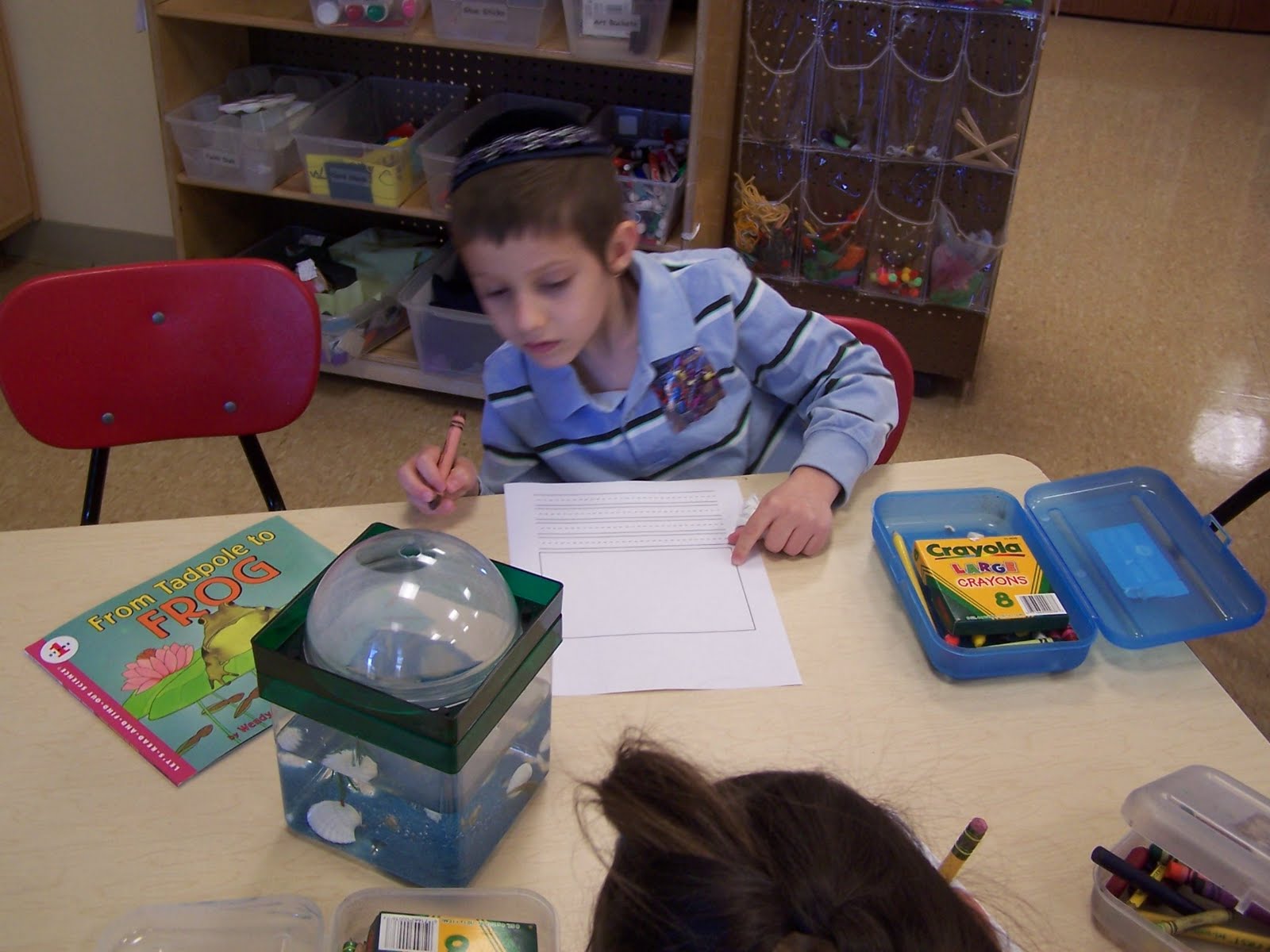
As the world continues to blossom and bloom around us during this season of spring, the children continue to observe and document the changes they see around them. This past week, the children were excited to notice that our tadpole has grown new front legs! Every morning, each child carefully sketches a picture of the changes they observe in our tadpole. We have watched his back legs grow longer and his tail grow shorter, and it was sure thrilling to see the beginning of his new front legs. After they complete their sketch, the children write about the changes they saw. To help them with their writing they use our word wall, familiar books and invented spelling.


The seeds we planted have started to grow, and we are excited about replanting them outside. The children enjoy pointing out the roots they see in our clear, see through planter. We are beginning to see some basil and tomatoes begin to sprout too. It’s exciting to observe first hand all we have learned about seeds.

The children were delighted to receive caterpillars! When they arrived, they were so tiny! In a couple of days, the children remarked how much they had grown. “Look Morah, this one is as big as the picture!” Joshua exclaimed excitedly. To learn more about the changes they will see, we read the book: Watch Me Grow, Butterfly. This gave us an opportunity to revisit the concept of symmetry. We also looked at many pictures of butterflies. Then, the children drew up a plan to create their own butterfly. They used tissue paper and markers to complete their plan, and this became the cover for their butterfly journal. It is exciting to anticipate all the changes we will see!

In math we explored how to use a ruler to measure. I asked the children, “What does it mean to measure?” They responded, “If you want that much of something, you have to measure!” “Measure how heavy something is!” “We can measure butter to see how much you need in ingredients.” “Let’s say you are making a building. You want it a certain size. You need to measure to make it that size.” “You can measure how tall and how heavy to see how strong you are!”

“Okay,” I said holding up a ruler, “Then what would we measure with this?” The children answered, “ A book and a calendar.” “How tall you are.” “How big a card is.” “Paper.” “How tall a can is.” We decided that everyone was correct! There were so many things we could use a ruler to measure. Next, we discussed that our rulers measure in inches. We learned how to line up the zero line to the beginning point of what we want to measure, and how to read the measurement. Then, we all had a chance to practice! The children enjoyed measuring with the rulers so much, that they often use them in their play.

Learning about bugs and insects was perhaps one of our favorite lessons so far! We had a chance to apply all that we learned when we created our own unique insects! The children took their knowledge of the parts of an insect, and how they live and survive, to create their own insect. They named their insect, drew a picture and told how their insect protected itself, where it lived, and what it ate. When we completed our project, the children then presented their insect to the class! Their ideas were so creative! Here is what the children said about their insects:


Valeria’s insect is a “Shoo Fly.” “He is a good bug. When he protects himself, he flaps his wings to shoo away the other insects. He eats the bad flies that kill plants. He lives in NJ, but he also likes to fly to Mexico!”


Levik’s insect is “Clowny Bug.” “He lives in Silly Town. He eats bread. He is a good bug because he shares his bread. He is nice to everyone, as his protection, so no one bothers him!”


Joshua’s insect is a “Walking Log” insect. “He lives outside the crevices of houses. He eats many ants. He is a very good bug because he has lightening bolts that kill bad bugs. He is strong too, and he can lift a person with his wings! This helps bring people to places.”


Peretz’s insect is a “Fivel on the Frying Pan” insect. “He protects himself by digging a big hole in the ground with nails on his feet. He eats cockroaches, so he is a good bug!”


Simona’s insect is a “MuskyAthing” bug. “He eats little, little, centipedes. He flies up in trees when he sees danger. He lives in NJ.”


Eliana’s insect is “a Plow Fly.” He lives in NJ. He is a good bug. He eats little, mean bugs. He could be a pet. When he puts his head down, he looks like a rainbow!”


Mendle’s insect is a “Googaly, Bubugaly, In Your Face and In Your Figaly” insect. He lives at the circus. He shoots poison from his foot to protect himself. He eats confetti! He is a good bug because he makes kids laugh!”

Let us know if you should see any of our insects!