Saturday, May 15, 2010

One of the most fascinating things we learned about insects was that they wear their skeleton on the outside of their body! It is called an exoskeleton. I asked the children where is our skeleton? They replied rather enthusiastically, “On the inside of our body!”

To help us learn a little bit more about our bones, Dr. Marcus, an orthopedic doctor, treated the kindergarten class to a special visit. He asked us, “Who knows what bones do?” Peretz responded, “They help us to be straight – without them we’d be all wobbly!” “That’s right!” said Dr. Marcus. Then he told us he would like to talk about his favorite bones as he held up an x-ray. “What does this look like?” he asked. “Bones!” yelled the children. “Yes, this is an x-ray of a hand.”

Dr. Marcus asked the children to think about the difference between our hand and a dog’s paw. “What is one thing you can do with your hands, that your dog’s paws can’t do?” he asked. “I drink with my hands, people can grab things and dogs can’t.” “Yes”, said Dr. Marcus, “What allows us to do this?” “Fingers!” said the class. To illustrate to the children that our thumbs help us grab things, Dr. Marcus taped the children’s thumbs to their hands and had them try to write their name. We could sure tell how much we need our thumbs after that exercise!
Our favorite part of the visit was when Dr. Marcus asked us “What do you do when a bone breaks?” “You get a cast!” replied the children. Then, Dr. Marcus gave each child a paper towel roll and we each got to put a cast on it, just as if it was a broken bone! And, of course, we all got to sign each other’s cast! Thank you Dr. Marcus for a fun and informative morning.


Our exploration of spring took us on a special field trip to do a pond study. While the children have been intrigued to observe and document the growth and change of our tadpole, and the transformation of our caterpillars in our classroom it was exciting to see and experience pond life up close! Upon our arrival, we were lucky enough (and quiet enough) to observe some turtles sunning themselves by the side of the big pond. Then we hiked up to the spring and learned that springs are the beginnings of all the ponds and rivers. While we were walking toward the spring, we noticed that the ground had gotten very wet. “Why?” I asked the children. “Because all the water is under the ground, under our feet!”

The children especially enjoyed feeding all the fish. It was very exciting when Joshua spotted frog eggs! “They look just like they did in the book!” We had never seen frog eggs, so it was fascinating to realize that was how our tadpole actually began. Now we had seen the complete lifecycle of a frog.

The cattails were also quite popular with the children! Here, the children agreed, they did not look just like they did in the books! They were much more “fuzzy!” Each child was so excited to get piece of the fuzz. Speaking of fuzz, we ended our stay by visiting the two goats on the property. They were quite friendly, and they sure enjoyed the attention and the matzah the children gave them.


Saturday, May 1, 2010

Spring

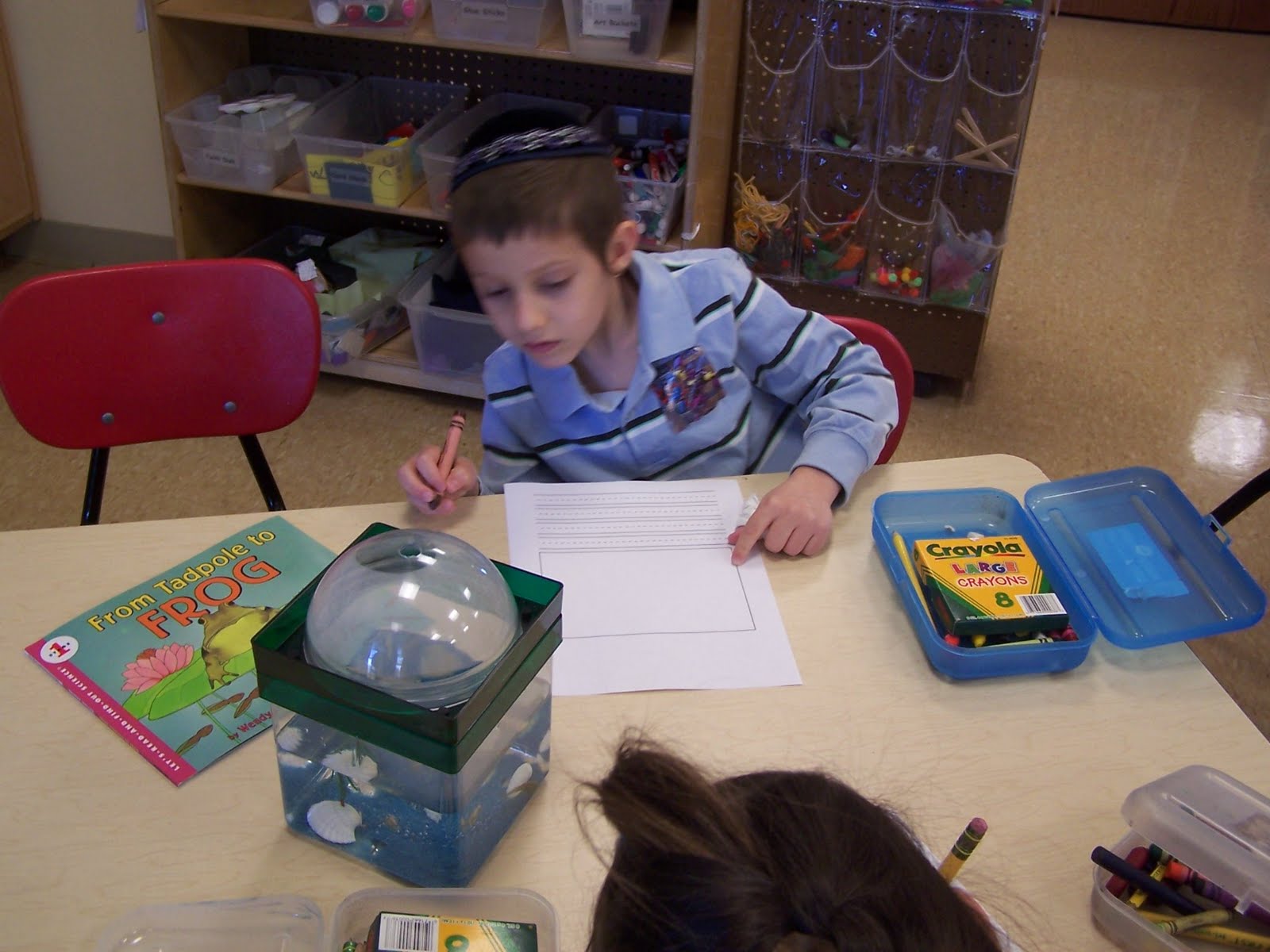
As the world continues to blossom and bloom around us during this season of spring, the children continue to observe and document the changes they see around them. This past week, the children were excited to notice that our tadpole has grown new front legs! Every morning, each child carefully sketches a picture of the changes they observe in our tadpole. We have watched his back legs grow longer and his tail grow shorter, and it was sure thrilling to see the beginning of his new front legs. After they complete their sketch, the children write about the changes they saw. To help them with their writing they use our word wall, familiar books and invented spelling.


The seeds we planted have started to grow, and we are excited about replanting them outside. The children enjoy pointing out the roots they see in our clear, see through planter. We are beginning to see some basil and tomatoes begin to sprout too. It’s exciting to observe first hand all we have learned about seeds.

The children were delighted to receive caterpillars! When they arrived, they were so tiny! In a couple of days, the children remarked how much they had grown. “Look Morah, this one is as big as the picture!” Joshua exclaimed excitedly. To learn more about the changes they will see, we read the book: Watch Me Grow, Butterfly. This gave us an opportunity to revisit the concept of symmetry. We also looked at many pictures of butterflies. Then, the children drew up a plan to create their own butterfly. They used tissue paper and markers to complete their plan, and this became the cover for their butterfly journal. It is exciting to anticipate all the changes we will see!

In math we explored how to use a ruler to measure. I asked the children, “What does it mean to measure?” They responded, “If you want that much of something, you have to measure!” “Measure how heavy something is!” “We can measure butter to see how much you need in ingredients.” “Let’s say you are making a building. You want it a certain size. You need to measure to make it that size.” “You can measure how tall and how heavy to see how strong you are!”

“Okay,” I said holding up a ruler, “Then what would we measure with this?” The children answered, “ A book and a calendar.” “How tall you are.” “How big a card is.” “Paper.” “How tall a can is.” We decided that everyone was correct! There were so many things we could use a ruler to measure. Next, we discussed that our rulers measure in inches. We learned how to line up the zero line to the beginning point of what we want to measure, and how to read the measurement. Then, we all had a chance to practice! The children enjoyed measuring with the rulers so much, that they often use them in their play.

Learning about bugs and insects was perhaps one of our favorite lessons so far! We had a chance to apply all that we learned when we created our own unique insects! The children took their knowledge of the parts of an insect, and how they live and survive, to create their own insect. They named their insect, drew a picture and told how their insect protected itself, where it lived, and what it ate. When we completed our project, the children then presented their insect to the class! Their ideas were so creative! Here is what the children said about their insects:


Valeria’s insect is a “Shoo Fly.” “He is a good bug. When he protects himself, he flaps his wings to shoo away the other insects. He eats the bad flies that kill plants. He lives in NJ, but he also likes to fly to Mexico!”


Levik’s insect is “Clowny Bug.” “He lives in Silly Town. He eats bread. He is a good bug because he shares his bread. He is nice to everyone, as his protection, so no one bothers him!”


Joshua’s insect is a “Walking Log” insect. “He lives outside the crevices of houses. He eats many ants. He is a very good bug because he has lightening bolts that kill bad bugs. He is strong too, and he can lift a person with his wings! This helps bring people to places.”


Peretz’s insect is a “Fivel on the Frying Pan” insect. “He protects himself by digging a big hole in the ground with nails on his feet. He eats cockroaches, so he is a good bug!”


Simona’s insect is a “MuskyAthing” bug. “He eats little, little, centipedes. He flies up in trees when he sees danger. He lives in NJ.”


Eliana’s insect is “a Plow Fly.” He lives in NJ. He is a good bug. He eats little, mean bugs. He could be a pet. When he puts his head down, he looks like a rainbow!”


Mendle’s insect is a “Googaly, Bubugaly, In Your Face and In Your Figaly” insect. He lives at the circus. He shoots poison from his foot to protect himself. He eats confetti! He is a good bug because he makes kids laugh!”

Let us know if you should see any of our insects!

Monday, April 19, 2010

Signs of Spring

As we returned from Passover break, the kindergarten children were delighted by all the signs of spring we noticed outside. We discussed how the season of spring invites us to experience our world through our senses in so many wondrous ways. As we enjoyed some beautiful afternoons outside, we took time to notice just how we used our senses to appreciate the beautiful season of spring. The children recalled the signs of spring they saw: flowers, buds and green grass; they heard: birds chirping, and a lawn mower; they smelled: flowers and the cut grass; and they felt: hot from the warm sunshine! Using a photograph taken of some flowers on our playground for inspiration, the children then painted their own spring flower pictures.

As we continue to explore and experience spring through our senses, we are reading about a remarkable young woman who was unable to experience the world as we do: Helen Keller. As we read about Helen Keller, the children are filled with questions! “How did she learn if she could not see?” “Why could she not take medicine to make her better when she got sick?” “Why couldn’t she talk?” Each day as we read another chapter, the children are fascinated and inspired by her story.

We began our study of plants by examining seeds. After reading The Tiny Seed, by Eric Carle, I introduced the children to a variety of different seeds in glass jars. I provided the children with a list of the seeds that were in the jars, and as they carefully studied each jar, they tried to guess what type of seed it contained! I asked the children how they came to their conclusions. They responded, “Well, I know that’s corn, because it looks just like corn!” “I think that is watermelon because I eat watermelon and that looks like the seeds.” “That might be broccoli because it’s green!” After we guessed each jar of seeds, we checked our answers. We did pretty well! Please stop in our classroom and try for yourself!

From seed to seedling to plant, we recalled all we know about how a seed grows! We read together, Watch It Grow, by Barrie Watts and then created our own plants using various art materials. The children labeled their work from roots to flowers using invented spelling and some help from our word wall. Then we enjoyed planting some seeds of our own! We planted basil, peppers, tomatoes, peas and beans! We can’t wait to see them sprout!


Much to the delight of our children, we got an early start on the study of pond life, when our tadpole arrived. To introduce him to the class, we read, Tale of a Tadpole and From Tadpole to Frog. Then we got busy studying his appearance. Each child drew a picture of him, and wrote about what he or she saw. This was the start of our Frog Journals. The children then made a cover page for their new Frog Journal, and each day the children record their observations through pictures and writing. They were very excited to observe his legs growing, and a dark green belly emerging!

Life is full of anticipation, and the spring season tickles us with excitement as we look forward to all the beauty spring brings. It is during this glorious season, that we count the Omer, as we anticipate the holiday of Shavuot. Each day one child counts out the days to Shavuot using cubes, and then breaks those cubes up into “weeks” to determine how many weeks and days to Shavuot. That child then writes it out in a sentence to post it in our lobby where we as a school community we are counting the days to Shavuot! As we count the Omer with anticipation, we are reminded that Hashem wanted to give us the Torah, this incredible gift that is our guide to life. Each day is met with the anticipation of being one day closer to Shavuot and of the ever-blossoming world around us!

Tuesday, April 6, 2010

Passover: An Authentic Learning Experience

Creating an authentic educational experience around the holiday of Passover was my ultimate goal as an educator. But, why reinvent the wheel? There is a plentitude of lessons, projects and crafts already available. How could I infuse the children’s learning with opportunities for personal understanding, meaningful dialogue, relevance and still be based upon state standards? The answer may surprise you…a puppet show!


We began our study as we often do, recalling information we already knew about the holiday. I wasn’t surprised to find out, that our kindergarteners knew quite a lot about Passover. They were not, however; without questions. And so, we created another list of all the questions they had about the holiday. For instance, the children knew we used a plate called a Seder plate, and they were even familiar with the items on the Seder plate. However, they pondered, “Can you use any plate to be a Seder plate?”

Using puppets, the children and I retold the story together. I filled in “the blanks” as we went. In the morning the children recalled information we had learned by answering the daily question in their journals. Each day we eagerly anticipated sharing the Passover story. Drawing on their excitement, I suggested to the children that we create our own puppet show, with themselves as the puppeteers that we could present to their families as well as the to younger preschool children. My suggestion was met with an enthusiastic response.


I invited Morah Adina, a wonderful artist to help us. The morning before she arrived, Morah Adina asked us to cut up strips of newspaper paper 1” x 3”. I explained to the children that we would use these strips to make paper mache¢ puppets! Levik replied, “Paper mache¢, I never made paper mache¢ before!” Eliana responded, “I did, and it’s yucky!” “Why is it yucky?” I asked. “Because,” she said, “it’s wet and sticky, but fun!”

Wet, sticky and fun…now we couldn’t wait! Morah Adina was met with joyful cheers from the children! She asked the children, “What project are we doing?” The class responded, “Making puppets!” “What kind of puppets?” Morah Adina asked. “Finger puppets,” replied the class. “Well, actually, hand and finger puupets,” said Morah Adina. “Why are we making puppets?” asked Morah Adina. “We are doing a Passover puppet show!” said the class.
Next, we needed to decide what puppet each child would make! We made a list of the characters together, and then put the characters name in a basket and each child choose one name. Here is our puppeteer lineup:

Moses: Rebecca, Aaron: Levik, Taskmaster: Valeria, Taskmaster: Simona, Pharaoh: Peretz, Miriam: Eliana
Jewish Slave: Joshua

As the children revealed which puppet they would make, we discussed how that puppet might look! Rebecca selected Moses. “Hmm, Moses who was he?” asked Morah Adina. “He led the Jewish people” said Rebecca. “What kind of leader was he?” asked Morah Adina. “He was good,” replied Rebecca. “Okay, so what do you think a good, strong leader might look like?” asked Morah Adina. After some thought, Rebecca replied, “I know, because he looks like the puppet Morah Melissa used!”

For each character the children tried their best to imitate what their facial expression would most likely be! Here’s our thoughts during this process: Joshua described a slave might be “crying because he wanted to leave.” “Miriam,” said Eliana, “would be a little happy, but a little sad too.” “Aaron would be a little happy because he helps Moses,” said Levik. “How about if Moses has a brown beard and Aaron has a white beard, because Aaron is older!” said Peretz. “How about the taskmasters?” inquired Morah Adina. “Mean!” said Simona and Valeria as they made angry, mean faces!


So now it was time to make the heads for our puppets. We started by rolling a piece of heavy paper to make a neck. Next we crumbled newspapers to make a ball and put aluminum foil around it to keep it together! Next was the super fun part! We used the strips of newspaper we had cut, dipped them in liquid starch and used our fingers like scissors to get rid of the excess and then, molded it onto our head! “Paper mache¢ is so much fun!” said Levik. “Oy, oy, oy, oy, it’s sticky!” exclaimed Rebecca. The children did a great job, and were proud as our puppet heads began to take shape!

During centers that same day, the children made a huge palace in the block area, and acted out the Passover story on their own! While they played, I encouraged them to think about what their character might actually say. This would help us as we begin to write our own script!

We needed another layer of paper mache¢ and upon its drying, we began to think about the actual face. Morah Adina brought in books and photographs for us to study. “We need to make a plan,” said Morah Adina. “So, let’s sketch the faces before we begin to create our puppet’s face!” “Oh, like before you build a house!” said Eliana. “Exactly,” said Morah Adina. The children really took their time with their sketches, making sure to capture the appropriate details.


Our puppet’s faces are all a bit different. Some children choose to use clay molded to the face for the features for added dimension, while others choose to paint them on later. We worked together to mix the paint to get the right color for the skin tone. The children decided that the skin would be light brown from being in such a warm and sunny climate. Once mixed, they set about painting their heads.


Selecting an outfit for each puppet required another plan! This time, we needed to make a template for gown, tape it to the fabric and then cut it out. The Morahs worked with each child to get just the right fabric for their puppet. We discussed together the type of material that would be appropriate. For example, Pharaoh needed to look regal and important, while a slave’s clothes might be tattered and worn.


Writing the script presented us with an opportunity to recall all that we had learned! We discussed the setting, and what each character would be doing. Who should speak first? What would that person say? What is our beginning? Once we settled on the beginning, we needed the middle of the story. What was happening? Who was speaking? Finally, the conclusion was discussed. How were the Jewish people feeling? What were they saying? What was happening? The children supplied lines, based upon what their character in the story!


Now we need to practice. We started by practicing without our puppets. We read through our script and talked about the tone of our voice. Was the character happy, angry, or sad? What would a person sound like who felt happy, angry or sad? We helped each other with ideas, as we practiced our lines.

Next it was time to practice with the puppets. Each child needed to find a way to manipulate his/her puppet while reading the script! The children worked together offering suggestions, helping each other with their lines and encouraging each other when one fumbled a bit with their part. Everyone was anxious and excited for our big day: presenting our puppet show to our families and the preschool children.

The day of the show as we rehearsed, the children’s exuberance and passion were evident. We had taken a remarkable journey together and their confidence and pride were soaring. Each day leading up to this one was filled with learning experiences that were exciting, relevant and meaningful. We had used Math Skills: units of measurement, geometric properties, transformed shapes, Science Skills: inquiry and problem solving, Fine Motor skills: cutting, molding shapes, painting, manipulating the puppets, Social-Emotional skills: exploring feelings, empathy, personality traits, Performance and Visual Arts Skills: portray characters, experiment with the use of voice, create works of art, present completed works, Language Arts Skills: fluency, reading strategies, vocabulary development, comprehension, writing, discussion, questioning, oral presentation, and Social Studies Skills: Utilize historical thinking, retell events, geography. And, we had great fun!

Can a puppet show provide a real and authentic learning experience? Absolutely!